
Part history, part protest, part celebration and all Indigenous: An Evening with Julia Keefe’s Indigenous Big Band
In our last blog post, we interviewed Julia Keefe, the vocalist and lead of Julie Keefe’s Indigenous Big Band. You might remember that the JKIBB is a 16-person all-Indigenous jazz ensemble that premiered in 2022. They perform jazz pieces from their predecessors in Indigenous jazz, as well as pieces from contemporary musicians. The band had their debut album, Incarnadine, released on May 8, 2026. It has recently been submitted for the Grammys, with four separate considerations. Incarnadine features pianist Marc Cary, trumpeter Delbert Anderson, bassist and vocalist Mali Obomsawin, trombonist Quinn Carson, drummer Edward Littlefield, as well as Julia Keefe herself and many more.
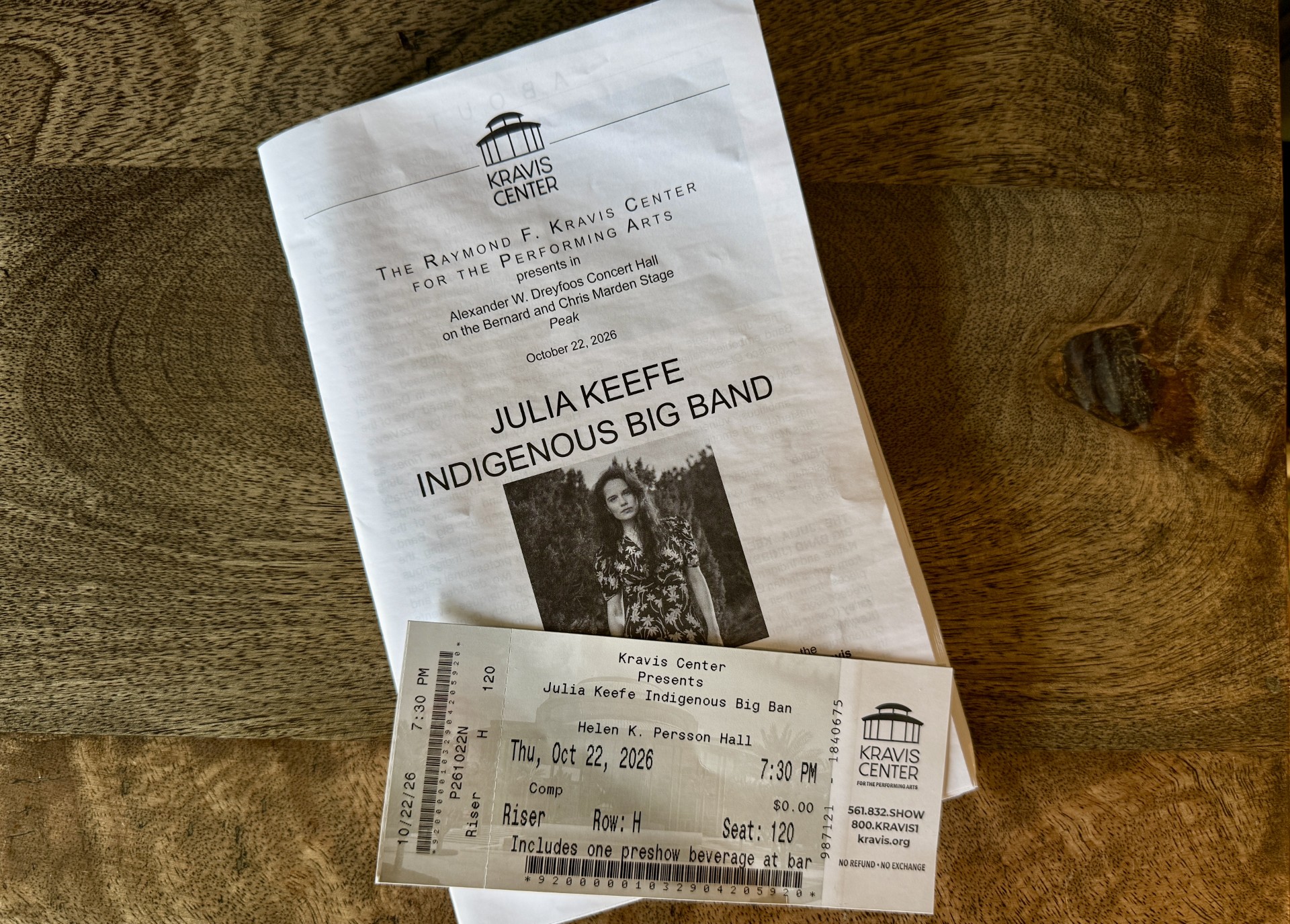
The Julia Keefe Indigenous Big Band recently performed at the Kravis Center for the Performing Arts in West Palm Beach, FL on October 22, 2026. We were lucky enough to attend this intimate, incredible performance. During the introduction, Julia Keefe stated that “the purpose [of the Big Band] is to build community with you all.” And you do feel that throughout the performance. Not only that you are a witness, but also that you are part of something. We had the privilege of experiencing it, and we have the privilege of sharing that experience with you today. Join us as we share our special evening with the Julia Keefe Indigenous Big Band!
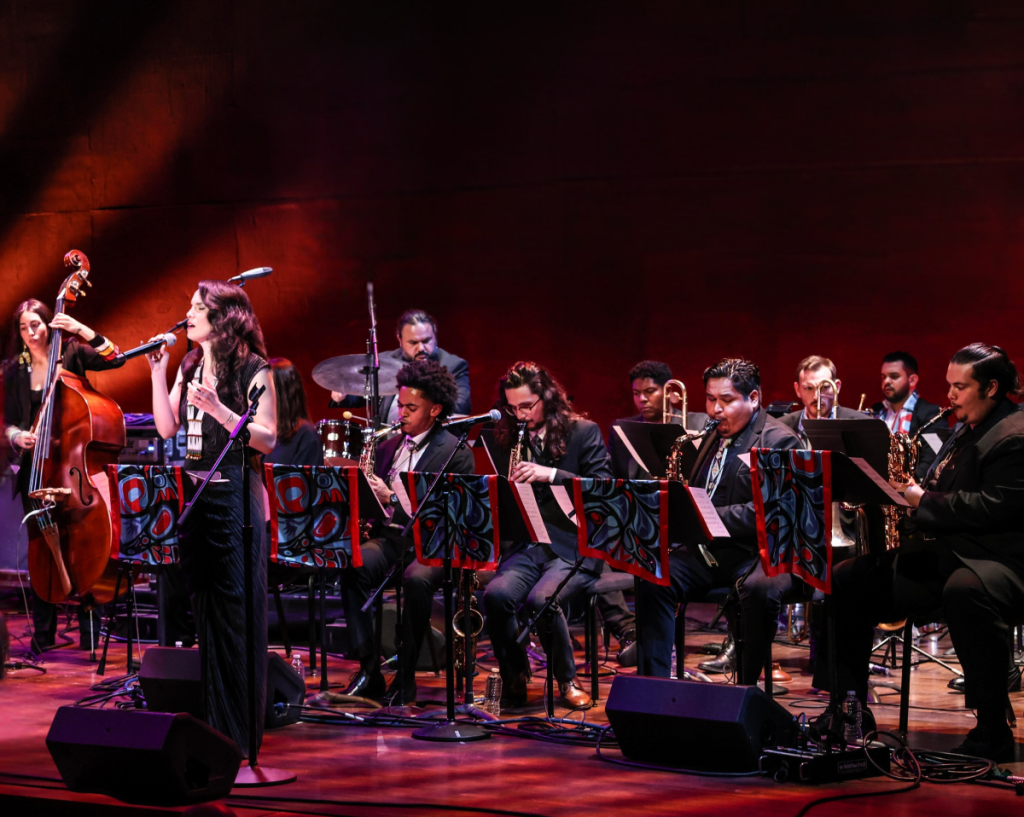
Our evening at the Kravis Center was a more intimate Big Band experience. We sat down in Persson Hall to a reduced version of the band – not all sixteen. But that had zero impact on the presence and impact of the music, which was mind-blowing from start to finish. We dove right into the first piece with no introduction, which was later revealed to be a Lingít melody. Ed Littlefield, on drums, gave a deeper description to the song and the original legend, which centers around a flock of finches flying overhead and their feathers are falling down on a woman. He went on to say “I hope our music falls on you gently like those feathers tonight.”
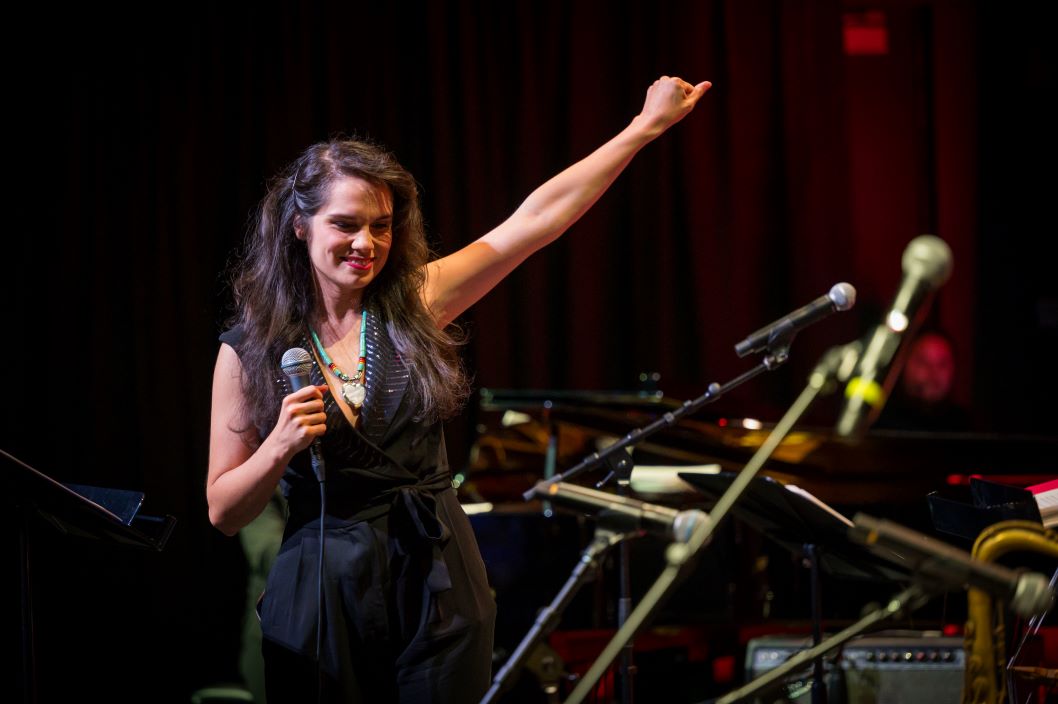
This first song set the tone for the entire evening. It felt, in many ways, like opening a door and being welcomed in. What followed was exactly what Julia Keefe described in our interview – “Part history, part protest, part celebration and all Indigenous.” An energetic, meandering journey through music, history, and culture, the Julia Keefe Indigenous Big Band somehow manages to make you feel gravity behind the music, while not taking itself too seriously. Julia herself is an irreverent, energetic, powerhouse of a vocalist and host. One moment she sends shivers down your spine with her vocals, and the next she’s stepping off to the side so another musician can be in the spotlight or making a joke. Threaded throughout the music is history, with Julia sharing more context behind the music itself and its impact for Indigenous Communities throughout Indian Country. While we won’t give you a full play-by-play of all the music of the evening, we will give you a little peek into the music, as well as some of the most moving moments. We encourage you to find time to listen to their newest album, and check back on their tour dates to support the Big Band.
Mildred Bailey (Coeur d’Alene)
The Julia Keefe Indigenous Big Band’s performance covers music from both Indigenous jazz musicians in history and contemporary artists. One of these is Mildred Bailey, a Cour d’ Alene jazz musician who was prominent in the 1920s and 1930s. Known as the “Queen of Swing” Bailey was one of the first full-time “girl singers” and worked with the Paul Whiteman Band. She is credited with helping launch Bing Crosby, who she knew from growing up in Spokane, WA. She grew up on the Cour d’ Alene Reservation in Idaho, before moving to Spokane and then eventually Los Angeles.
This evening, Julia Keefe performed Mildred Bailey’s “Lover Come Back to Me.” She also emphasized the impact that Bailey has had on her. You may remember Julia sharing that impact last during our interview. She stated that “For a long time, I didn’t really acknowledge that I was Native. Until I stumbled across the name of Mildred Bailey, who was one of the first women to front a big band in the late 1920s, and she was Native. She was from Coeur d’Alene tribe, so then I was able to talk about this Native woman singer from history. And being able to say ‘oh, see, there’s a historical precedent for me to be here.’ Then I felt like I had the permission to exist as my whole self on the bandstand.”
Jim Pepper (Kaw/Mvskoke),
Another name from history threaded through the performance is Jim Pepper. Pepper was a Kaw/Mvskoke jazz saxophonist, composer and singer who became a pioneer in fusion jazz. He was particularly notable for his continued efforts to showcase his own cultural roots in his music. Keefe noted in the performance the importance of that. “Pepper’s Powwow,” his debut album, released in 1971. It had significant influence from Pepper’s cultural roots, including the peyote chant “Witchi-Tai-To” which Pepper had learned from his grandfather, Ralph Pepper. This ceremonial chant blended Indigenous spiritualism with fusion jazz and became one of the most recognizable fusion moments of the time. Keefe noted during the performance that Pepper recorded and released “Witchi-Tai-To” in 1969. At that time there were many aspects of Indigenous life and religion that were still illegal. The American Indian Religious Freedoms Act would not be passed until 1978, making “Pepper’s Powwow” an act of resistance just by existing.
Keefe’s vocal performance of “Witchi-Tai-To” was incredible. One of the most electric moments of the entire evening, she gave herself totally to the music. Her robust vocalis gave a life to the chant that was incredibly moving, allowing you to feel the power behind it. Every song that was performed this evening you could feel that power, from Jim Pepper’s ‘Water,” Queen Lili’uokalani’s “Kuʻu Pua i Paoakalani,” or Julia Keefe’s own ‘Sonnet.’ It was not only a performance to remember, but one to cherish.
Contemporary Arrangements
In addition to these historic influences, the big band also played a few contemporary pieces, flowing from Julia Keefe’s own composition, ‘Sonnet,’ to a three-movement suite by Delbert Anderson. One of the founding members of the Julia Keefe Indigenous Big Band, Anderson’s suite was another moment that you could just feel. The presence of the music was, for the lack of a better word, chewy. It felt important, and heavy in its importance. In the first movement, “Narbona,” named for a mountain pass that goes through the Navajo nation, they encourage you to “listen for the mountain pass and the wind traveling through the mountains.”
The second movement, “Attention,” was dedicated in honor of Diné code talkers. Starting off with the rat-a-tat-tatt of military style drumming, it builds in presence in a way that is a beautiful and resistant. Indigenous people enlist in the military at a higher per capita than any other racial group. This is called out in the song, where the lyrics pointedly state “First to rise but the most neglected, Indian veteran always gone unprotected…. If we defend freedom can we take it home too?”
The third movement, “Iron Horse Gallup,” follows the story of a long overnight train ride from Gallup, NM to Los Angeles, CA. The frenetic, delirious quality of the music is dizzying. Ending with a splash, the suite was one that runs you along a whole gamut of emotions, from the eerie whistling of the wind to a delirious trip through the desert.
Julia Keefe’s Indigenous Big Band
There are almost no words to describe how you feel watching the Julia Keefe Indigenous Big Band perform except ‘if you have a chance to see them live, do it.’ Each person in the band is a star in their own right, and if you are looking to see passion in music, it’s here. But, there’s also weight to it, even with the lighter pieces.
The band’s final piece was “Blood Quantum” (M. Obomsawin, arr. A. Burik). Leading into the piece, Keefe shared more about Blood Quantum laws. First imposed by white settlers in the 18th century, blood quantum laws quantify Indigenous ancestry by fractions, denying Indigenous identity to those who aren’t “native enough” based on their blood. Keefe noted how dangerous blood quantum laws are in her introduction, stating that this painful legacy is pushed in the eventual hope that there will no longer be native people. The piece is raw, emotional, and at sometimes painful. There are moments during Keefe’s vocalization that her voice almost feels like its bleeding. But there is also resistance, as the band builds with their own voices to add to the texture and strength of the piece.
Indigenous people have a long history with ensembles, jazz, and big bands, Keefe shares, one that is rooted in the Indian Boarding school system. In 1892 R.H. Pratt would utter the infamous words “Kill the Indian in him and save the man.” This framework would drive policy in both Canada and the United States, aimed at eradicating the culture when they could not kill the people. The residential school system, forced migration, and cultural assimilation policies were all aimed at separating the people from their culture. Pratt would go on to found the Carlisle Indian School, where Keefe’s own great-grandmother attended. Learning these western instruments, those from these Indian schools would go on to bring that back to their communities, making their own ensembles and music.
Throughout the evening, you get pieces of history and context threaded in with the music, with the express purpose that you leave the room with a better understanding. Not just of jazz, and not just of Indigenous history. But instead, of perspective. Today, Keefe sings in a language that her own great-grandmother would have been forbidden to acknowledge. The band plays music that would have been illegal to perform. They are wholly present in their identities, each sharing their tribal affiliations in their introductions. This underlines Keefe’s final point and last remarks before the end of the performance. That despite everything, Indigenous people still exist.
In spite of boarding schools, in spite of blood quantum. Indigenous people are still here and will continue to be here. – Julia Keefe