
A Beautiful Education with Julia Keefe’s Indigenous Big Band
Today, we have a special treat for you! Next week on October 22, 2026 the Julia Keefe Indigenous Big Band will be playing at the Kravis Center for the Performing Arts in West Palm Beach, FL. In the first part of this special two-part series, we will be chatting with Julia Keefe about the Julia Keefe Indigenous Big Band, their new album, what it means to be an Indigenous jazz musician, the upcoming show at the Kravis Center, and so much more! Follow back in two weeks for our experience attending the performance. Please note that some portions of our conversation were redacted for brevity.
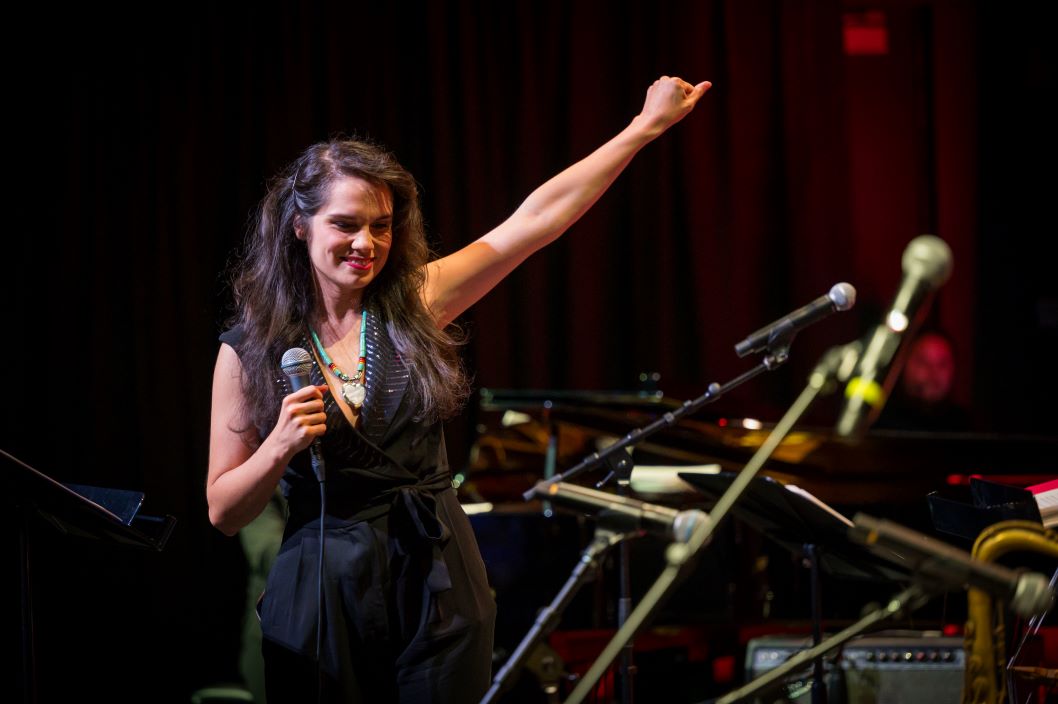
In our featured image, you can see Julia Keefe performing as lead vocalist with the Julia Keefe Indigenous Big Band (via juliakeefe.com)
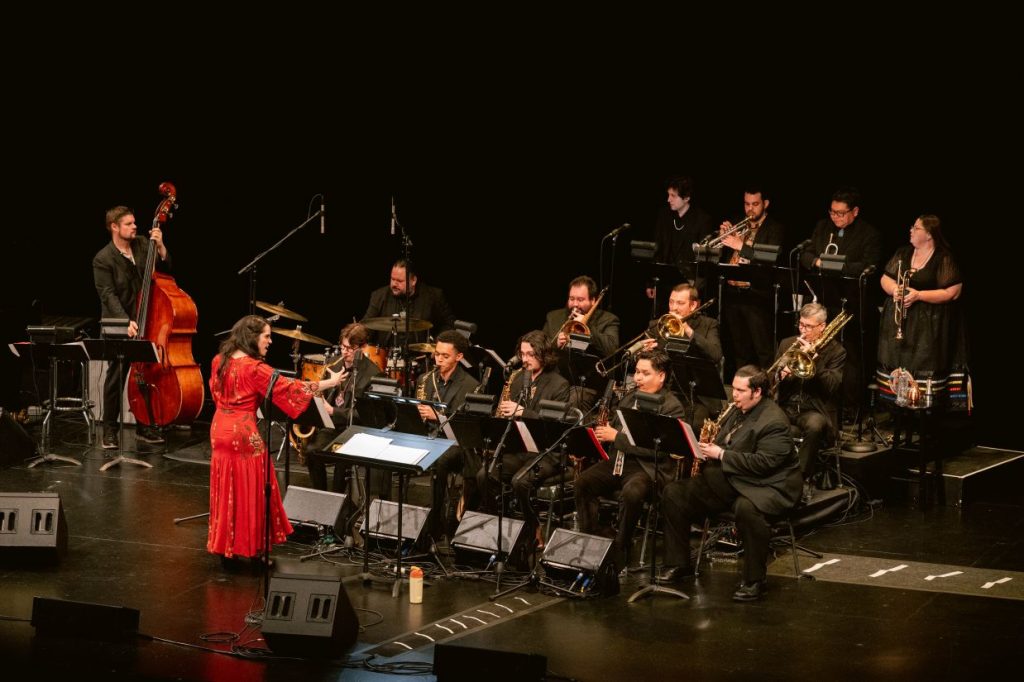
The Julia Keefe Indigenous Big Band
The Julia Keefe Indigenous Big Band, headed by vocalist Julia Keefe, is a 16-person all-Indigenous jazz ensemble that premiered in 2022. They perform pieces from under-appreciated predecessors in jazz, like Mildred Bailey (Coeur d’Alene) and Jim Pepper (Kaw/Mvskoke), alongside works by contemporary Indigenous composers. They spotlight and carry on the legacy of previous Indigenous jazz composers and performers. The band had their debut album, Incarnadine, released on May 8, 2026. It has recently been submitted for the Grammy’s, with four separate considerations. Incarnadine features pianist Marc Cary, trumpeter Delbert Anderson, bassist and vocalist Mali Obomsawin, trombonist Quinn Carson, drummer Edward Littlefield, as well as Julia Keefe herself and many more.
Chatting with Julia Keefe
DB: Thank you so much for talking to me….I appreciate the opportunity to talk with you. I’m really excited to go to your show on the 22nd, and I’m excited to learn more about jazz.
JK: Thank you so much for agreeing to interview me and to highlight the work of the band and the larger Indigenous jazz network that we’re trying to build. It’s all about building community and supporting each other and increasing representation. For those little kids, like urban Indian kids or rez kids who just don’t see themselves reflected in the music that they love or up in the bandstands. That’s totally what we’re all about.
DB: So, something that I find very interesting about your ensemble specifically is you have so many different Indigenous cultural identities that are being represented all at the same time…. Do you feel like your ensemble is sort of a reflection of taking back community, and representing it in the music, because so many different people are putting little bits and pieces of themselves into it?
JK: Totally. When I decided to start the big band I wasn’t interested in creating some homogenized distillation of ‘what is Indigenous jazz’ or ‘what is Indigenous music.’ I don’t want to create one singular sound because we’re just too diverse, right? So, the purpose of this band is very much to highlight and marinate in the different cultures that are represented within the band. We have the work of Queen Lili’uokalani in our repertoire, and we get to experience that history with colonization because it’s the overthrow of the kingdom of Hawaii. I feel like it’s so much closer to home for a lot of native Hawaiians. It’s much more recent than for a lot of other folks, and so being able to understand that experience through the music, that active rebellion and resistance. Then to also experience the music and the appreciation and tie to music with the Navajo Nation. Or tribes up in the northeast, what their [ties to] music are and their cultural practices around music. What I love is that within the band we have this shared experience of being Indigenous peoples in a colonized land. And we have this shared language of jazz, but we also get to learn so much from each other, the different cultural norms and protocols for each of these different tribes and nations that are represented. It does feel like we’re taking back that space and presenting that unified front. It’s been a really beautiful education for all of us to see each other and each other’s cultures in this improvisatory and collaborative space.
DB: How is the process of creating with all of those different identities? Is it very collaborative where you are all discussing what’s next, or choosing whose voices to highlight, or how is that process with so many different people and identities coming together?
JK: Usually folks in the band, if they have a song that they have written or a song that comes from their people and were like “oh I’d really love for the big band to play this.” Then we have arrangers within the band. I’ve also hired arrangers to help us arrange that music. Then we get to live in that world sonically. So, it is a very collaborative process. But I have also noticed people have their own individual voices. The way that Delbert Anderson, who’s Diné from Navajo Nation solos on his trumpet, is different from the way that Kalí Rodríguez-Peña, who’s Taíno from Cuba solos. So, being able to sort of express themselves within these larger compositions, that also feels like a statement of cultural identity.
But, in terms of our repertoire I’ll ask people of the band ‘hey, do you have something you want to bring from an Apache tribe?’ Or ‘One of your original songs, would you like that to be played in the band?’ It really is just folks bringing what they would like to bring to the band and we flesh that out together. And then we try it out. One of my favorite things that has happened is, my drummer, Ed Littlefield, he’s Lingít from up in Alaska, and he has worked with Rogan Kahale, who’s Kānaka Maoli from Hawaii. Rogan has arranged Ed’s song and it’s this Lingít lullaby that has been reinterpreted and reimagined through a jazz lens.
It’s really cool to be part of that, being able to facilitate that process and bring these people together. I love that the band members get to work together and dream things up together and then we get to try it out within the ensemble.
DB: That is such a fantastic collaboration because you’re thinking about two Indigenous identities, one from Alaska and one from Hawaii. We think of them as so disparate, and they are, but at the same time, now they’re in this jazz space together creating something.
JK: Thank you. It’s been a really beautiful process, and I think a healing process. For so long we’ve all been so isolated. Not only as tribes, but also as Indigenous jazz musicians, that’s super niche. That’s a super niche type of person.
DB: Obviously your process as an artist has been long, over your lifetime. But how was the process of becoming who you are now? Not just a jazz musician, but an Indigenous female jazz musician. How was it realizing that identity about yourself?
JK: It took me a long time to really allow for the marriage of those two identities to coexist at the same time. When I was coming up, I loved jazz. I grew up listening to jazz. My earliest memory was listening to Billie Holiday. So, I’ve always loved music, and obviously, I’ve always been Native. But, when I started singing, and singing professionally, I was in my early teens. And when I would introduce myself as a Native American jazz singer, folks in the audience would get kind of mad about it, ‘what do you mean, you’re a Native American jazz singer?’ Well, I’m native and I like to sing jazz. I don’t know why you were so upset right now. But I do think that for folks who came to my gigs, those two identities just didn’t mesh in their brains, right? No way can these two things exist in one body at the same time.
For a long time, I didn’t really acknowledge that I was Native. Until I stumbled across the name of Mildred Bailey, who was one of the first women to front a big band in the late 1920s, and she was Native. She was from Coeur d’Alene tribe, so then I was able to talk about this Native woman singer from history. And being able to say “oh, see, there’s a historical precedent for me to be here.” Then I felt like I had the permission to exist as my whole self on the bandstand, which is such a bummer. I hate that people’s preconceived ideas of what it is to be Native or what it is to be a Native musician, that those [preconceived ideas] really had such a profound impact on me as a young teenage musician. But also I wanted [to say] ‘You were a teenager. It’s fine, and you were just trying to navigate other people’s complex emotions.’
DB: It’s part of the whole reason that highlighting stories like Mildred Bailey, and honestly, like you now, is the example to tell us that it’s possible. To train your brain to say, ‘Oh, it’s been done before. This road has been walked.’
JK: Exactly, exactly. Also, even if it hasn’t been walked, I’m allowed to take up space in my entirety. That’s something that I’ve only really learned in the last decade….. Infusing Indigenous melodies into my jazz music really only started happening after I met Delbert [Anderson] and started forming the band or the early sort of incarnations of what the band would become. Meeting with other Indigenous jazz musicians…. Then it was okay, I’m seeing what other people are able to do with their cultural identity and their musical identity and how they put both into practice musically. By being able to see them do that, I felt, again, I was able to give myself permission to do it. And it felt genuine and authentic. I remember in college one of my well-meaning teachers was like, just take a powwow song but make it a swing tune. That feels so false, right? It’s my culture, but it feels like cultural cosplay just for the sake of someone else. So being able to do it, organically, with a group of other Indigenous jazz musicians. There’s the safety of being able to explore that and explore that genuinely. It’s taken so much time. It’s taken so much time to really feel like I can do this. Like I can exist as my whole self, and I’m just so glad. I really do think that the work that I’ve done with the big band and bringing this community together has really healed a lot of that for me.’
DB: I read on your bio that the idea for the ensemble really coalesced in COVID times. How was taking those steps for you? How did that sort of come together?
JK: I met Delbert [Anderson] during COVID. We were connected through a mutual friend on Facebook and it was just supposed to be a half hour conversation to see if I would be a good fit to partner with Delbert on a grant. That half hour conversation turned into a 3-hour conversation, geeking out really hard on all things jazz, and jazz in Indian country, and Indigenous musicians who rose to prominence within the genre of jazz. Then offhandedly, it was ‘man, wouldn’t it be cool if we had like an all-native big band today?’ I was like, ‘oh yeah, that’d be so cool. If you do it, be sure to hire me.’ ‘No, you’d be sure to hire me.’
And then we laughed about it and put that idea aside, put it on the shelf. Because there’s also a part of me that was ‘you’re the only other Native jazz musician I know. I don’t know that we’re going to be able to put together a big band.’
DB: An ensemble of two.
JK: Exactly, a big band of two, our little big band. Then the South Arts’ Jazz Roads Creative Residency grant came about. That came about because nobody was touring and usually they fund tours by way of their grants. So, they put together this larger grant called the creative residency to help artists during COVID dream up their bigger projects. And Delbert called me, “Hey man I think you should apply for this, and I think you should apply for the native big band idea. Because I think you’re the person to lead it.”
It really was the encouragement of Delbert that led me to put together this behemoth of a proposal. I went through the whole history of Indian boarding schools and survivors coming out with this knowledge of Western music and these Western instruments and the music of the time. In the 20s and 30s and 40s jazz music was the most popular art form and so we had these territory bands of big bands and marching bands and smaller jazz ensembles. I guess it was a compelling, compelling proposal because I was awarded full funding. I was awarded $40,000 to put together the big band, have a residency, then premiere the band…. I was so excited to see this major funder believe in Indigenous art and especially Indigenous jazz…. But then, of course, shortly thereafter came that panic inducing realization of ‘I only know Delbert. Oh my god, what have I done?’
I had to lead a big call for artists. I was reaching out to colleges and universities and native student unions and a big call for artists on social media. And the feedback was actually really overwhelming. People from all over the US and Canada were reaching out to me, as young as 14 and as old as in their 90s. The 14-year-old, he was a kid in rural Oklahoma, just like ‘hey, I thought I was the only Native person who liked jazz.’ No, my brother, we are all out here.
DB: That must have been very crazy for you. I mean, having those beginning conversations with Delbert and thinking you are one of two, to seeing this ginormous community that’s waiting for you.
JK: Yes, exactly. And it was just so cool because when people would reach out, like “oh man, I am so excited. I can’t wait to meet everybody. Even if I am not able to make the gig please keep me posted, I would love to meet you all.” The big band is sixteen people. But the network, all of the folks who have reached out. I think that first round, I got over like 50 people from all over the US and Canada. It’s gone up to like 80 or 90 people now as we’ve been touring. More and more people are like “I didn’t know this was a thing. Please keep me posted, I would love to jump on the bandstand if there’s ever an opportunity.” Part of it is putting together a band so we can make cool music. But the other part is we are building a community and wanting to connect all of these people together so they can support each other and hire each other and make music together. That’s the ultimate goal for me for sure.
DB: The ensemble had an album come out in March. I’ve been listening to it this week. How was that process for you? Did it feel kind of like the realization of a dream?
JK: It really is the realization of a dream. I think again that sort of taking up space, taking up the sound waves. But it was also to celebrate the work of this amazing group of humans. For it to finally come out, it was such a big deal, and I’m so proud of that album. You know, when we went into the studio, I was like, okay, at best we’ll have an album. At worst, we’ll have some reference recordings for new musicians jumping on the bandstand with us…. But the music turned out so beautifully and the band plays with such passion. It was like the music itself was asking to be heard by folks outside of our community, of our little jazz network. To release it and the feedback that we’ve had, the reviews, it’s just been so awesome. Really lovely. I just submitted the album for the Grammys, which is wild, super cuckoo bananas. It’s just a love song to this band and to the jazz musicians from our tribes and nations that came before us. It is the taking of space that I think is long overdue, and I’m just, I’m happy to play a part in it for sure.
DB: Especially as someone who’s coming in, not knowing a lot about jazz, not listening to a lot of jazz. It felt still fresh and relevant to me in a way that I enjoyed the experience.
JK: Oh, good. Yeah, I know jazz can get such a weird rap. I don’t know why it’s been painted as this inaccessible sort of ‘high art’ art form. Yes, it is. But also, it’s folk music. I think it’s all folk music and that’s kind of the approach that I take with this band. Yeah, we’re diving into some complex issues and we’re playing some complex chords, my brothers. But, it is all folk music and it is all about storytelling. That is the oldest art form, right? Just speaking about the human experience through music. I think in that way we’re not up there sort of, waxing poetical or, you know, sonically self-gratifying. That’s not the purpose. No we’re telling our people’s stories and we’re telling them in the ways that are appropriate for our people’s stories.
DB: So you have the performance on the 22nd at the Kravis Center. What do you want people who walk in to take away from that show?
JK: The show is like part history, part protest, part celebration and all Indigenous…. I want people to have this broader understanding of jazz history. It’s not that we’re trying to rewrite jazz history. That’s definitely not it, but we are broadening the scope. Native people have been here. Indigenous people. We’re there at during the birth of jazz, and we have been active in jazz throughout its entire lifetime and we are still active participants in this all-American art form. I hope that historical context sort of broadens people’s ideas about jazz. I hope people learn a little bit more about Indian country. But I also just hope that people have a really good time and enjoy the storytelling.
DB: I know that recently there has been significant defunding in the arts. How do people support you and the ensemble?
JK: Oh man. So, the best way to support live music is to go out and show up to the performances…. Supporting artists by buying their merch, their CDs, their vinyls from them directly. But also, this is such a huge legislative issue. And I know we’re getting into voting season but actively voting and petitioning your representatives to increase funding for the arts. We have to hold our leaders accountable for this active deregulation and underfunding of arts education. Of course, supporting artists directly, but then also going out and really taking your politicians to task is probably the best thing we can do.