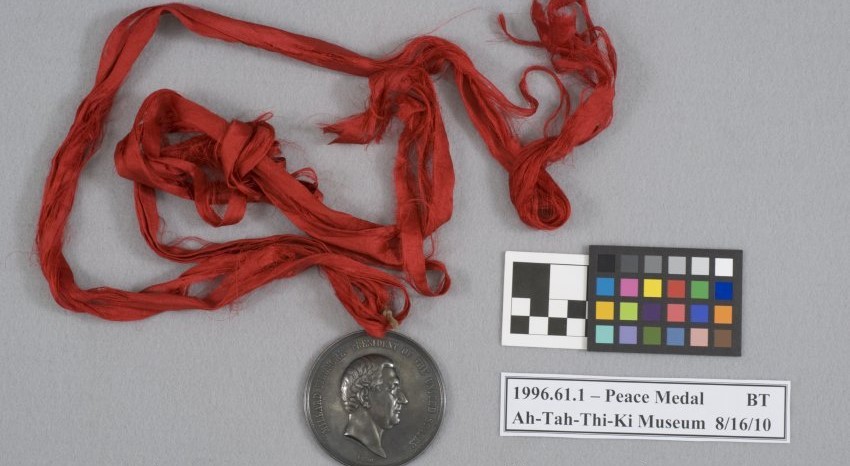

The Legend Behind “Pumpkins of the Devil’s Garden”
Next week, the Ah-Tah-Thi-Ki Museum will be hosting their annual “Pumpkins of the Devil’s Garden” exhibit opening event. But, what is the Devil’s Garden? And who is the Devil? This week, join us as we share this spooky legend, along with a dash of history, leading up to the exhibit opening! You can find all the information you need to know to attend at the end of this blog post.
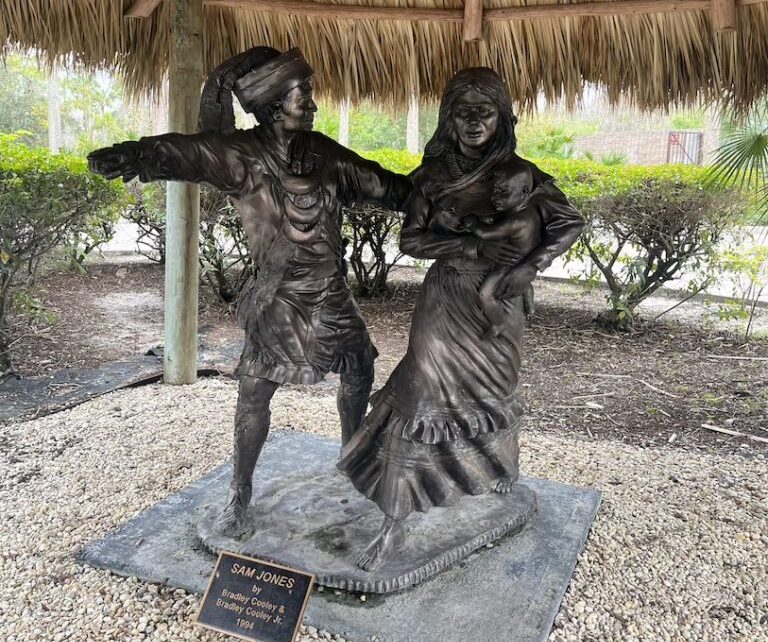
In our featured image, you can see a sculpture of Abiaka (Sam Jones) in front of the Ah-Tah-Thi-Ki Museum. He is leading a Seminole woman carrying a baby. Without Sam Jones, the Seminole Tribe of Florida would likely not exist. James Billie shared in a 2014 editorial with the Seminole Tribune that “Eight clans followed Sam Jones down here to escape the soldiers. Bird, Wind, Panther, Snake, Bear, Frog, Deer and Otter. Not all the clans followed Abiaki. Many were taken to Oklahoma. Raccoon, Sweet Potato, Long Hair Clan, none of them exist here anymore.”
The Legend of the Devil’s Garden by Gordon Wareham, via the Ah-Tah-Thi-Ki Museum
There was a being who was a devil…a demon. They would describe him as 4 feet tall, as an elongated head with eyes, nose, and a mouth. He was bright red. His arms came out from behind his ears, and stretch to the ground easily. He moved around, by using his long arms, and walking on his large hands.There were gardens in the area. This being, or devil would go to people’s gardens, or farms, and ransacked them. He kept a stick tied to the back of his head. Strings attached to the ends of the sticks, and baskets would hang from the ends of the strings. When he wanted something from the gardens, he would balance his whole body on his chin, quickly collect things with his hands, and placed them in the baskets.
When he moved, it was like a red blur! If you shot at him, you would miss him. When he laughed, it sounded like a thousand animals being slaughtered. It caused people to freeze in terror. The more he moved around, the more he laughed, the brighter red he became. He could be seen as a bright light in the distance.
They would tell young children in caution: “If you see a bright light in the distance, or in the fields, don’t go out exploring the light. It could be a trap, not a campfire nor a torch.
Words from the storyteller, Gordon Wareham: When I was a child, my mother would say “If it looks like a car in distance, don’t investigate! Look in the morning!” The moral of the story: ‘When it is late at night, you do not go out wandering off, and stay close to the camp!’
STOF-THPO, Seminole History Stories, July 2022
Who Was the Devil?
Also known as Abiaki, Arapeika/Aripika, Sam Jones, or just “The Devil,” Abiaka was a fierce Miccosukee wartime leader, medicine man, and spy. He would rally the Seminole people against removal during the wartime period, leading them deep into the Everglades and away from the clutches of the United States. As the Seminole Wars drug on, it became clear that violent resistance was the only option against removal and the decimation of their entire culture and way of life. Famously, Abiaka is quoted as saying: “In Florida I was born. In Florida I will die. In Florida my bones shall bleach.” Those who followed Abiaka would become the Seminole Tribe of Florida. He would pass away in 1867, reportedly at the age of at least 111.
“That ol’ Devil,” James Billie writes, in the same 2014 editorial mentioned above, “It was almost a romantic term. You know: ‘That ol’ Devil escaped us again!’” Abiaka was known for employing guerilla warfare tactics against US forces, often shooting first in battle, guiding it, and tending the wounded. He would appear from nowhere, strike, and then retreat back into the swampland like a ghost. U.S. forces began to call him “the Devil” for his almost supernatural abilities. Other stories described how “Abiaka would appear, and a war cry would be heard from an unknown location. Then he would disappear and the warriors would strike. This led many soldiers and settlers to believe that he had the ability to summon the creatures of the land in battle.”
Abiaka was steadfast in his opposition to removal. “Starved, surrounded, sought with a vengeance, Sam Jones would answer no flag of truce, no offer of compromise, no demand of surrender. His final camp was in the Big Cypress Swamp, not far from the Seminole Tribe’s Big Cypress community of today” (as requoted in the 2016 article in Fort Lauderdale magazine, original source unknown.)
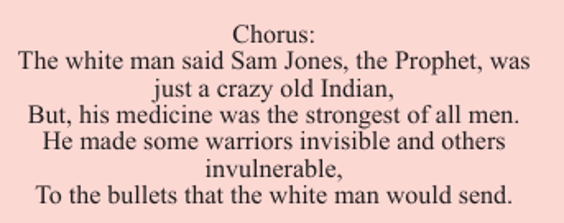
Excerpt from “The Battle of Okeechobee” by Ann Thomas which appeared in the December 31, 2014 edition of the Seminole Tribune.
An Ephemeral Legend
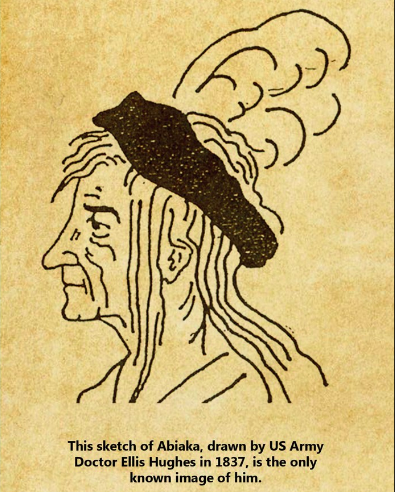
One aspect of Abiaka’s legend is how flexible and mutable he was. Other than one poor line drawing (above), no one seemed to know even what he looked like. Soldiers even gave him the name “Sam Jones” after a popular song “Sam Jones the Fisherman.” He would appear at forts like Fort King and sell fish to soldiers as an eccentric, feeble old man. Then, he would use the opportunity to spy, gathering intelligence for Seminole forces. As Abiaka, he was a great wartime tactician. It seemed, in effect, that he again had an almost supernatural ability to become who he needed to be to further the Seminole cause. He would play a number of roles to gather information, then become the leader he needed to be in battle. As the United States’ military presence and pressure increased, Abiaka’s role in the Seminole resistance would become that of legend. In particular, historians credit him with being a brilliant military strategist, even directing the Battle of Okeechobee in 1837.
Even the physical descriptions of Sam Jones vary wildly. Sam Jones, the feeble old man, is a stark contrast to the Devil, supernatural warrior. Artist depictions reflect this shifting identity. Below, you can see “Sam Jones Stand” by the late Seminole artist Noah Billie. Billie painted it in 1993, over 130 years after Sam Jones’ death. Abiaka stands with a rifle directly pointed at the viewer. He is wearing traditional Seminole clothing, including a red turban with a plumed feather, leather-fringed bandolier bag, yellow handkerchief, white shirt, black vest, leather leggings, and green and white garters on top of tall moccasins.
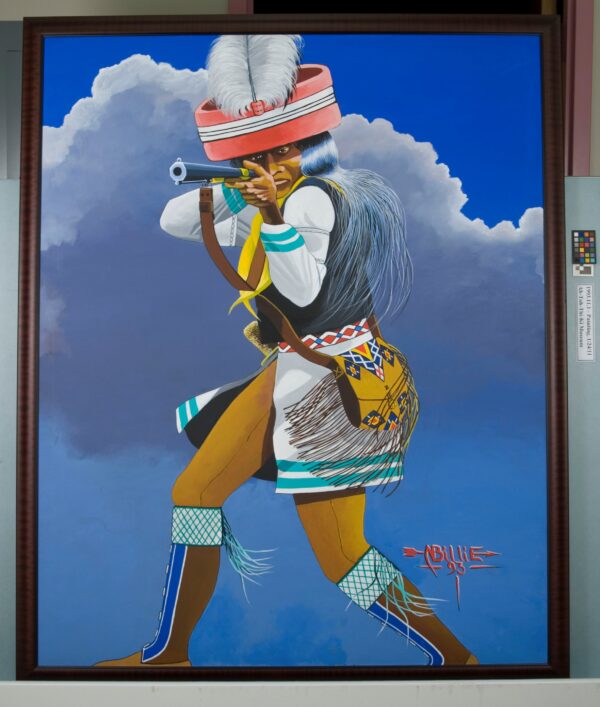
(1993.11.1, ATTK Museum)
Notice the differences between the Noah Billie painting, Bradley Cooley’s bronze sculpture, and Guy LaBree’s painting below. In his painting, LaBree shows Abiaka and two others making their way through sawgrass.
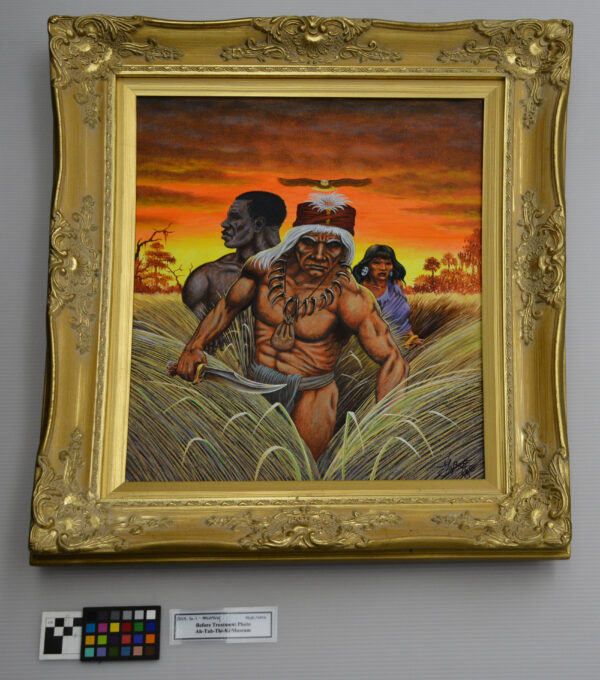
(2017.16.1, ATTK Museum)
But which, if any, of these are true? Maybe all of them…
What was the Devil’s Garden?
We noted above that Abiaka lived around the now-Big Cypress Seminole Indian Reservation. The Devil’s Garden was just that, the space attached to Abiaka’s name where he made his home. Not only did Abiaka establish a camp in the Big Cypress Reservation area, but he also had camps throughout the Everglades. James Billie explained that: “Sam Jones started it all back in the 1800s when he and his followers planted bananas, pumpkins, corn, sweet potatoes and other vegetables on fertile hammocks in this area. U.S. soldiers were on a mission to capture these Seminoles and almost did. Surprised by the soldiers, the Seminoles ran off into the swamps, leaving their gardening tools behind. History tells us that one soldier, looking at the scene, declared, ‘This must be The Devil’s Garden.’”
If you recall from our previous blog posts about Seminole gardens, land would often be cleared in hammocks so gardens could be protected and hidden. The natural landscape of hammocks would shield them from prying eyes. This was particularly important during the Seminole War period, where Seminoles would often also disguise their gardens not to look like gardens, making them difficult for US troops to spot and destroy. Dave Scheidecker, Research Coordinator for the Seminole Tribe of Florida’s THPO shared that gardens would “always be in a hammock separate from where they lived, up to a mile away. One (hammock) for living, one for the garden.” This meant if “someone finds one, you still have the other.” Hammocks were regularly used for gardens up through the mid 20th century for protective purposes.
It makes sense, then, that Seminoles would have planted multiple gardens, abandoning those that became compromised. They would have been nearly impenetrable by US forces and flourished with edible food.
Linking the Devil’s Garden on the Big Cypress Reservation is also the Devil’s Highway, or Sam Jones’ Trail. In 2015, CR 833 was renamed “Sam Jones’ Trail” by Hendry County, after a proposal by the STOF-THPO. In the formal proposal documentation, former THPO research assistant David Brownell wrote that: “The uniqueness of the Sam Jones Trail is twofold. The trail is positioned to connect four watersheds that were crucial to the survival of the Seminoles and connected the different coasts of Florida…. In addition, the Devil’s Garden locale was so remote that the trail remained in its native, unpaved state far into the 20th century, used by Seminoles to move between camps and hunting areas, long after many other trails had been destroyed or forgotten by modern development.” Brownell would later state that “there are many historic references to Sam Jones in many places, never more than a mile or so from today’s road. It’s remarkable how closely the road matches the trail when we overlay their maps.”
You can learn a little more about Sam Jones’ Trail and other Historic Trails on the Big Cypress Seminole Indian Reservation in a 2023 STOF-THPO Storymap.
Pumpkins of the Devil’s Garden Event
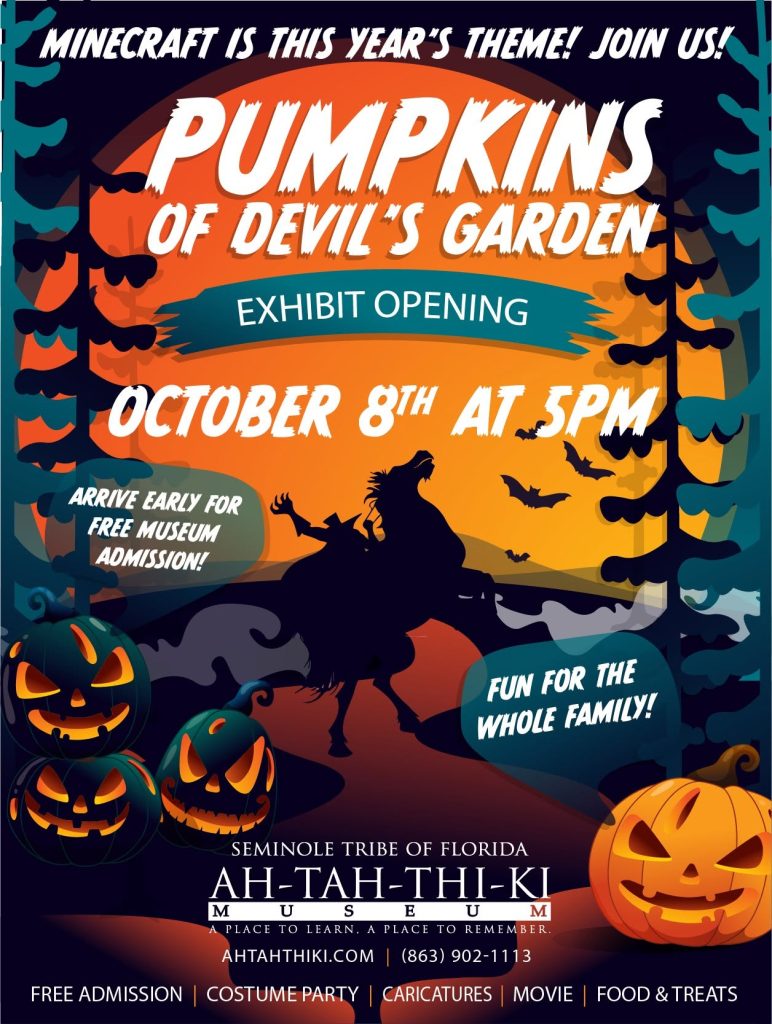
This year’s event will be held Thursday, October 8th starting at 5 pm at the Ah-Tah-Thi-Ki Museum. This family-friendly Halloween exhibit is created through community effort, with people of all ages submitting pumpkins to be featured in the garden. Stroll through the sculpture garden at the Ah-Tah-Thi-Ki Museum and catch glimpses of pumpkins and scarecrows that will frighten and delight.
This year’s exhibit opening party theme is “Scarecrows and Minecraft.” Halloween costumes or themed dress are encouraged! There will be snacks and treats, as well as complimentary face painting and caricature artists. There will also be a FREE screening of the Minecraft movie, complete with popcorn. Need another reason to go? The Ah-Tah-Thi-Ki Museum exhibit space will be CLOSING for renovations after November 9, 2026 for an 18-month period. Make sure to come by and visit while you can!